Why MES, Validation, and Automation Are Taught Separately (But Fail Together Without Integration)
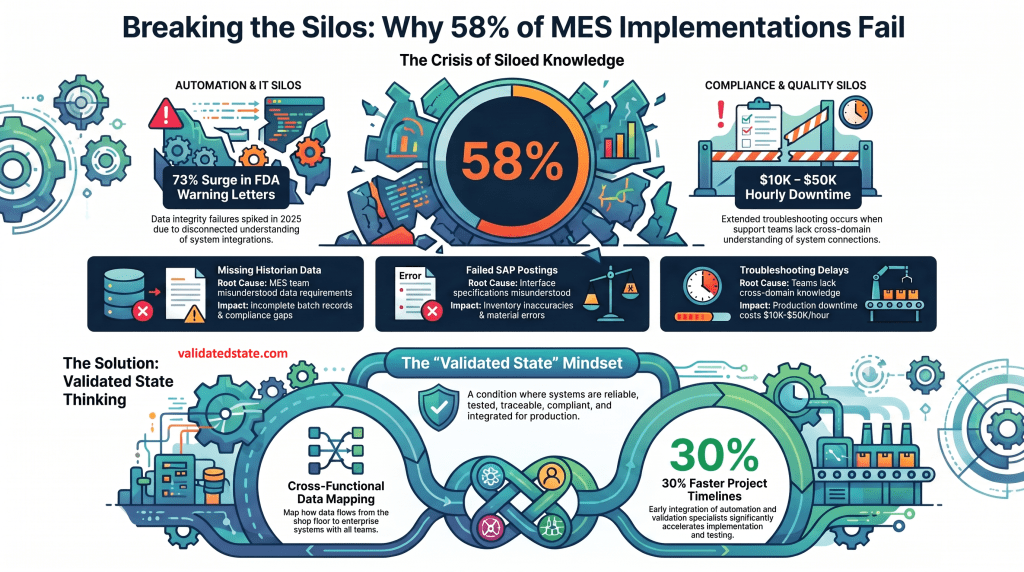
The manufacturing industry treats MES, validation, automation, and IT/OT as separate domains, but this siloed approach causes 58% of MES implementations to fail. In 2026, we need integrated knowledge, not isolated expertise.
Key Takeaways
- The global MES market reaches $18.61 billion in 2026, yet nearly six out of ten implementations fail to deliver expected results (Fortune Business Insights, 2026; Blue Net, 2026)
- FDA warning letters surged 73% in 2025 due to data integrity failures, often stemming from disconnected system understanding (Zamann Pharma, 2026)
- Over 75% of leading manufacturers now implement IT/OT convergence, proving integrated thinking is the future (ITECS, 2026)
The Conventional View: Expertise in Isolation
Most training programs, certifications, and industry resources treat MES, validation, automation, and IT/OT as distinct disciplines. Universities offer separate courses on control systems, quality management, and enterprise software. Professional certifications focus narrowly on CSV, GAMP 5, or specific MES platforms.
Vendors market their solutions in isolation. MES vendors sell MES, automation vendors sell PLCs, and validation consultants sell compliance documentation.
This separation exists for historical reasons. Manufacturing automation evolved from mechanical engineering, while IT systems grew from enterprise computing. Validation emerged as a regulatory requirement separate from both. Each domain developed its own terminology, standards, and professional communities. The result is a landscape where MES engineers understand batch execution but not control system integration, validation specialists know GAMP 5 but not OPC UA, and automation engineers master PLC logic but not electronic signatures.
Industry publications, conferences, and online communities reinforce these silos. MES conferences focus on software features, automation shows highlight control hardware, and validation summits discuss compliance frameworks. Few venues address how these pieces fit together in real manufacturing environments.
The problem compounds when project teams form. An MES implementation might include experts from each domain, but without shared understanding, they speak different languages and make assumptions that create gaps during integration and validation.
Why This Is Wrong: The Cost of Disconnected Knowledge
When MES, validation, and automation knowledge remain siloed, real manufacturing systems suffer. The most visible cost appears in implementation failures. Nearly six out of ten MES implementations fail to deliver expected results, with integration issues and poor data connectivity cited as primary causes.
Problem 1: Integration Gaps Create Data Blind Spots
When MES engineers don’t understand control system data structures, they design interfaces that miss critical process parameters. When automation engineers don’t understand MES data requirements, they configure equipment to send incomplete or incorrectly formatted data. The result is eBRs with missing values, historians with data gaps, and SAP with inaccurate consumption postings.
In one pharma manufacturing site, an MES-to-historian interface failed because the MES team assumed the historian would accept all batch events. The historian team, working from different specifications, had configured their system to reject events without specific metadata. The gap wasn’t discovered until after go-live, requiring expensive rework.
Problem 2: Validation Becomes a Documentation Exercise
When validation specialists don’t understand the technical architecture, they treat CSV as a paperwork requirement rather than a risk-based testing approach. They create test cases that verify documentation completeness but fail to test critical integration points. The FDA’s 73% increase in warning letters in 2025 highlights this issue, with repeated data integrity failures and weak CAPA systems cited as common findings.
Pharmaceutical compliance failures often occur when validation is treated as a one-time documentation exercise rather than an ongoing scientific control activity. This approach misses the interconnected nature of modern manufacturing systems.
Problem 3: Troubleshooting Takes Longer, Costs More
When production support teams lack cross-domain understanding, they struggle to diagnose issues that span multiple systems. An operator reports that material consumption isn’t posting to SAP. The MES support engineer checks the MES logs and finds the transaction was sent. The SAP team checks their system and finds no incoming message. Without understanding the middleware, network infrastructure, and interface specifications, the teams point fingers while production waits.
In regulated environments, these delays have direct financial impact. Every hour of downtime in a pharma facility can cost tens of thousands in lost production. Extended investigations also increase the risk of compliance findings during audits.
What the Data Shows: The Integration Imperative
The manufacturing industry’s digital transformation makes integrated knowledge non-negotiable. The global MES market reaches $18.61 billion in 2026, with growth driven by the need for operational efficiency and regulatory compliance. Yet this growth coincides with increasing complexity, as manufacturers connect more systems and generate more data than ever before.
The Integration Challenge
52% of SMEs report facing integration issues with digital manufacturing systems, while 49% lack skilled professionals who understand the connections between MES, automation, and enterprise systems. This skills gap manifests in project delays, cost overruns, and systems that don’t deliver their promised value.
The Compliance Cost
In 2025, the U.S. FDA issued more than 327 Warning Letters in just six months, a 73% increase compared to 2024. Inspection reports consistently highlight repeated data integrity failures and weak CAPA systems—both symptoms of disconnected system understanding. Indian manufacturing sites received warning letters at a 60% rate, with associated data integrity issues far surpassing rates in the U.S. (10%) and China (21%).
The Convergence Trend
Manufacturers recognize the need for integration. Over 75% of leading manufacturers had implemented some form of IT/OT convergence by 2025, driven by the need for real-time visibility and operational efficiency. This convergence isn’t just technical—it’s organizational. Teams that bridge the IT/OT divide achieve up to 20% gains in operational efficiency.

The Security Imperative
IT/OT convergence also introduces new risks. Manufacturing has been the most ransomware-targeted sector globally for four consecutive years, with attacks surging 61% in 2025 alone. Dragos tracked 119 ransomware groups hitting roughly 3,300 industrial organizations in 2025, with more than two-thirds of victims in manufacturing. Secure integration requires understanding both IT security protocols and OT reliability requirements.
The Better Approach: Validated State Thinking
A manufacturing system is only valuable when it is reliable, tested, traceable, compliant, integrated, and ready for real production use. We call this condition the validated state.
Validated State thinking connects six areas that are typically explained separately:
- MES Engineering – The software that manages batch execution and operator workflows
- eBR Design – The electronic records that capture production activities and compliance evidence
- Validation & Compliance – The processes that prove systems work as intended and meet regulatory requirements
- Industrial Automation – The control systems (PLC, DCS, SCADA) that monitor and control equipment
- IT/OT Convergence – The integration between enterprise IT and shop-floor OT systems
- Production Support – The ongoing maintenance and troubleshooting that keeps systems running
Core Principles of Validated State:
- Systems thinking: Understand how MES, ERP, SCADA, DCS, historians, and LIMS work together in real manufacturing environments
- Risk-based validation: Apply CSV and CSA principles based on system criticality and patient/quality impact
- Integration-first design: Plan interfaces and data flows before configuring individual systems
- Production-ready mindset: Build systems that operators can use effectively during actual manufacturing campaigns
Validated State isn’t about becoming an expert in every domain. It’s about understanding enough of each area to design, test, and troubleshoot systems effectively. An MES engineer doesn’t need to program PLCs, but they do need to understand how control system events trigger MES workflows. A validation specialist doesn’t need to configure historians, but they do need to understand how historian data supports compliance requirements.
We’ve seen projects transform when teams adopt this mindset. One biotech manufacturer reduced their MES implementation timeline by 30% by involving automation engineers in eBR design sessions and validation specialists in interface testing. Another pharma company reduced post-go-live issues by 40% by creating cross-functional troubleshooting guides that mapped symptoms to potential root causes across multiple systems.
How to Apply Validated State Thinking
Start by mapping your manufacturing data flow. Trace how information moves from the shop floor to enterprise systems: SAP creates production orders, MES manages batch execution, eBR captures operator activities, control systems send equipment events, historians store process data, and LIMS manages quality results. Identify every hand-off and interface.
Step 1: Build Cross-Functional Knowledge
Have each team member spend one hour shadowing a colleague from another domain. An MES engineer sits with an automation engineer during equipment commissioning. A validation specialist reviews interface specifications with an IT integration expert. Document three things you learned that you didn’t know before.
Step 2: Create Integrated Design Documents
Create design documents that include:
- System architecture diagrams showing all integrated systems
- Data flow maps for each critical process
- Interface specifications with field mappings
- Validation approach for each integration point
- Production support procedures for each system
Step 3: Develop Cross-Domain Troubleshooting Guides
Build a living document that helps support teams diagnose issues spanning multiple systems. Include:
- Common symptoms and their likely root causes
- Which logs to check in which systems
- Who to contact for each type of issue
- Escalation procedures for multi-system problems
Step 4: Join the Validated State Community
ValidatedState.com provides the practical knowledge and resources to help you develop integrated understanding. We offer guides on MES fundamentals, eBR design, validation approaches, automation concepts, IT/OT convergence, and production support, all written to help you see the connections between these domains.
We’ve applied this approach in our own work, and we’ve seen the difference it makes. Projects run smoother, systems integrate better, and teams troubleshoot faster when everyone understands the bigger picture.
Caveats: What Validated State Doesn’t Do
Validated State thinking doesn’t replace deep expertise. You still need MES engineers who understand software configuration, automation engineers who can program PLCs, and validation specialists who know regulatory requirements. What it does is provide the context that makes that expertise more effective.
This approach also doesn’t guarantee project success. Nearly six out of ten MES implementations still fail, and many failures stem from organizational issues like poor change management, unclear requirements, or inadequate resources. Validated State thinking addresses the technical knowledge gaps, but projects still need strong leadership, clear objectives, and proper execution.
Finally, Validated State focuses on regulated manufacturing industries—pharma, biotech, medical devices, food manufacturing, and specialty chemicals. While many concepts apply to other sectors, our examples and guidance are tailored to environments where compliance and validation are critical requirements.
Frequently Asked Questions
Why do so many MES implementations fail?
Nearly six out of ten MES implementations fail to deliver expected results, primarily due to integration issues, poor data connectivity, and lack of cross-domain understanding. When teams don’t understand how MES connects with control systems, historians, ERP, and other enterprise systems, they create gaps that manifest as missing data, failed transactions, and compliance issues.
How does IT/OT convergence affect validation?
IT/OT convergence increases the complexity of validation because it introduces more interfaces, more data flows, and more potential failure points. Validation must extend beyond individual systems to cover the integrations between them. This requires understanding both the technical architecture and the regulatory requirements for interconnected systems.
What’s the first step to improving cross-team understanding?
Start with a data flow mapping exercise. Gather representatives from MES, automation, IT, validation, and production support in a room. Map how data moves through your manufacturing environment, from shop-floor equipment to enterprise systems. This exercise reveals gaps in understanding and creates a shared mental model of your integrated systems.
Conclusion: The Time for Integrated Thinking Is Now
Manufacturing systems are too interconnected, too complex, and too critical to be understood in isolation. The validated state—a condition where systems are reliable, tested, traceable, compliant, integrated, and ready for production—requires integrated knowledge.
The data is clear: MES implementations fail when teams lack cross-domain understanding, compliance suffers when validation is disconnected from technical reality, and efficiency gains remain elusive when IT and OT operate in silos. Over 75% of leading manufacturers have already embraced IT/OT convergence. The question isn’t whether to adopt integrated thinking, but how quickly you can develop it.
ValidatedState.com exists to accelerate that journey. We provide the practical knowledge, examples, and resources to help MES engineers, validation professionals, automation specialists, and IT/OT teams understand how manufacturing systems work together in real production environments.
The validated state isn’t just a condition for your systems. It’s a mindset for your teams.
References
- Fortune Business Insights, Manufacturing Execution Systems Market Share Report, Forecast 2026-2034, https://www.fortunebusinessinsights.com/manufacturing-execution-systems-market-110827 (2026)
- Blue Net, MES Failure Root Causes: Integration, Data, and Infrastructure, https://www.bluenetinc.com/mes-failure-root-causes-integration-data-infrastructure (2026)
- Zamann Pharma, Computer System Validation in Pharma: 2026 Compliance and Inspection Expectations, https://zamann-pharma.com/2026/04/13/computer-system-validation-in-pharma-in-year-compliance-and-inspection-expectations/ (2026)
- ITECS, Manufacturing Cybersecurity OT and IT Guide 2026, https://itecsonline.com/post/cybersecurity-for-manufacturing-ot-it-convergence-guide-2026 (2026)
- Business Research Insights, Digital Manufacturing Market Outlook 2026–2035, https://www.businessresearchinsights.com/market-reports/digital-manufacturing-market-119787 (2026)
- Pharma Manufacturing, Top 7 pharma manufacturing regulatory stories of 2025, https://www.pharmamanufacturing.com/compliance/article/55340503/top-7-pharma-manufacturing-regulatory-stories-of-2025 (2025)
- Dassault Systèmes, What Are IT and OT in Manufacturing and Why Does Connecting Them Matter?, https://blog.3ds.com/brands/delmia/what-are-it-and-ot-in-manufacturing-and-why-does-connecting-them-matter/ (2025)