A unified namespace (UNS) is an event-driven architecture in which every system in a plant publishes its current state to one central broker, organized in a semantic hierarchy that mirrors the business. Any producer writes to it. Any consumer reads from it. Nothing integrates point-to-point. The result is a single, live source of truth: at any moment, the UNS holds the current state of the enterprise, structured so a human or a machine can find any value by walking a tree.
This article is the first in a ground-up series on the UNS. Here I define the term precisely, show where it sits in the ISA-95 functional hierarchy, and explain report-by-exception, the data-flow change that makes it work. I use one fictional plant, the Auralis Pharma packaging site at Westbridge, as the running example for the whole series.
Key Takeaways
- A UNS is three things combined: a central broker, a semantic topic hierarchy, and a live retained state. Remove any one, and it stops being a UNS.
- The UNS is not a historian, not a data lake, and not a protocol. It holds the current state; other systems hold history.
- In ISA-95 terms the UNS is not a new layer. It is a backbone that spans Levels 0 through 4 and carries events between them.
- Report-by-exception inverts industrial data flow: producers publish on change instead of consumers polling on a timer.
- Retained messages mean a new subscriber sees the full plan state the moment it connects, without asking any device anything.
What Is a Unified Namespace?
The shortest accurate definition I can give: a UNS is the current state of the business, published as events into one brokered, semantically organized structure that every system can read.
Three properties carry all the weight in that sentence. First, one brokered structure: there is a single logical hub, and every producer and consumer connects to it rather than to each other. Second, semantically organized: data lives at addresses that describe the business (enterprise, site, area, line, or cell), not at addresses that describe a network card or a PLC memory register. Third, current state: the UNS answers “what is true right now,” and it answers instantly.
The Three Ingredients: A Broker, a Semantic Hierarchy, and Live State
The broker is the hub. In practice, this is usually an MQTT (Message Queuing Telemetry Transport) broker, a lightweight publish-subscribe server designed for unreliable industrial networks. Producers publish messages to named topics; consumers subscribe to the topics they care about. The broker sends each event out to every subscriber. I will treat MQTT mechanics such as quality-of-service levels, sessions, and wills in a dedicated article later in this series.
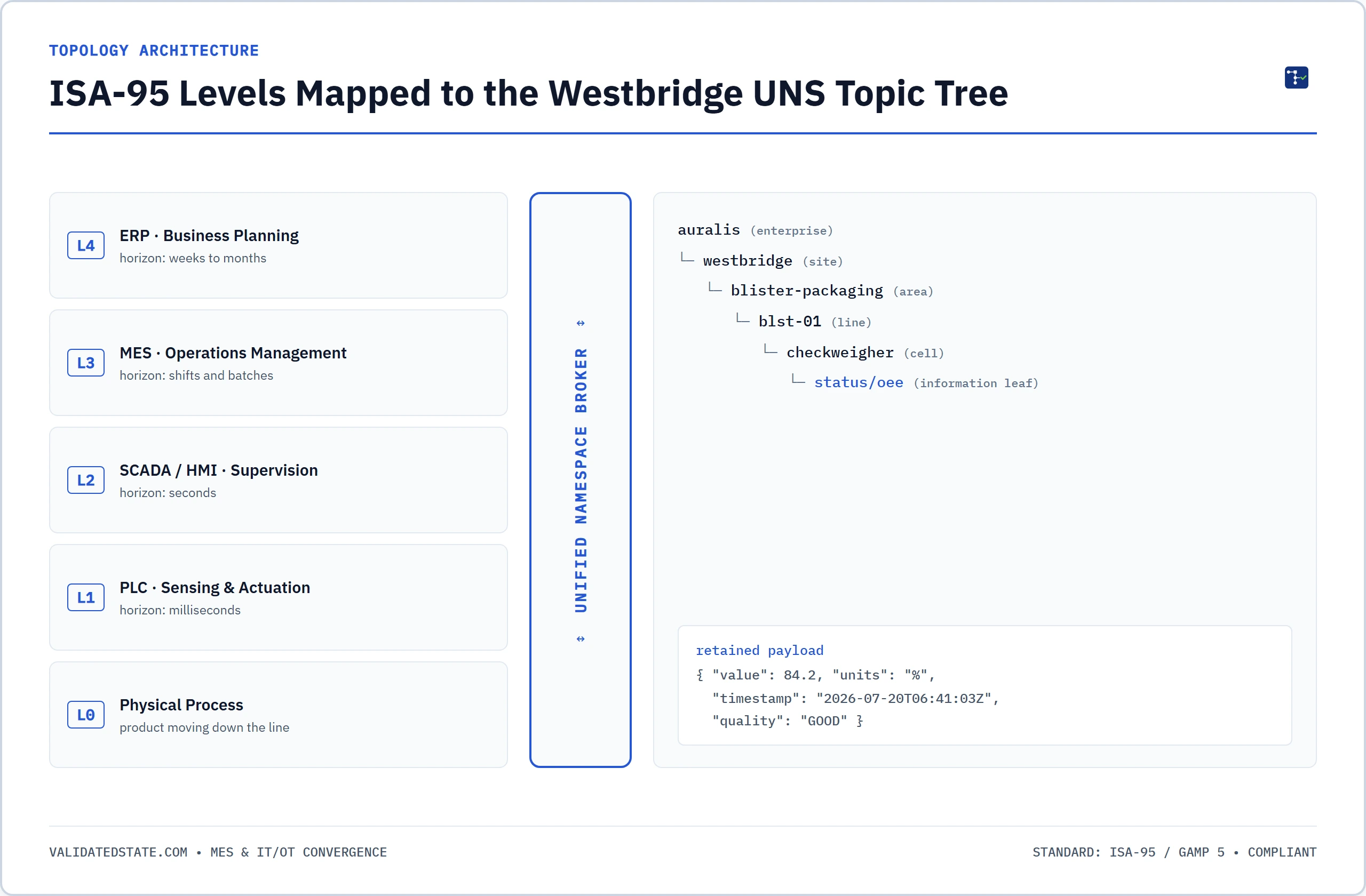
The semantic hierarchy is the namespace itself. Topics are arranged as a tree that mirrors the organization, and the ISA-95 equipment model is the natural template. At Westbridge, the checkweigher on blister line 1 lives at
auralis/westbridge/blister-packaging/blst-01/checkweigher
Anyone who understands the plant can guess that path. That guessability is the point: the namespace is self-documenting.
Live state is the third ingredient. The broker retains the last published value on each topic. Subscribe to the tree, and the broker immediately delivers the most recent value of every topic under it. The UNS therefore behaves like a snapshot of the whole plant that updates itself in real time.
What a UNS Is Not: Not a Historian, Not a Data Lake, Not a Protocol
The UNS holds now. It deliberately does not hold them. A historian subscribes to the UNS and records every event into time-series storage; a data lake or lakehouse does the same at enterprise scale. Both are consumers of the namespace, not the namespace itself. When an engineer asks, “What was the reject rate on blst-01 last Tuesday?” the historian answers. When a dashboard asks, “What is the reject rate right now?” the UNS answers.
The UNS is also not a protocol. MQTT is the most common transport because retained messages and broker-side fan-out map directly onto the three ingredients, but the UNS is an architectural pattern. I have seen teams treat “broker installed” as equivalent to “UNS achieved.” A broker with flat, device-oriented topic names like plc7/db20/dbw14 is just plumbing. The semantic hierarchy is what turns plumbing into a namespace.
What Problem Does the UNS Actually Solve?
Industrial software grows by accretion. A plant buys a SCADA (Supervisory Control and Data Acquisition) system, then an MES (Manufacturing Execution System), then a historian, then a quality system, then a maintenance system, and each new arrival is wired directly to the systems it needs. Every wire is a custom interface: its own protocol, its own mapping table, its own failure modes, and its own owner, who left the company two years ago.
In my MES integration work the pattern repeats: the second system costs one interface, the fifth costs four, and by the tenth nobody can draw the diagram from memory. The mathematics is unforgiving: full interconnection of N systems needs N×(N−1)/2 links. Six systems can mean fifteen bespoke interfaces, each individually testable and collectively unmanageable. I walked through a concrete case of this pain in MES-DCS integration patterns.

From Integration Spaghetti to Hub-and-Spoke
The UNS collapses the wiring problem to one connection per system. Each system publishes what it knows and subscribes to what it needs. Adding an eleventh system means one new connection to the broker, not ten new interfaces, and the ten existing systems do not change at all. The new system inherits the entire plant’s data the moment it subscribes.
That is the whole pitch at foundation level. The full failure analysis of point-to-point integration (cost curves, brittleness under change, silo effects, and the triggers that justify migration) deserves its own treatment, and it gets one in the next article of this series.
Where Does the UNS Sit in the ISA-95 Hierarchy?
ISA-95 (IEC 62264) defines the functional hierarchy every plant engineer knows, and it is the frame I use to place the UNS precisely. If the levels are new to you, I wrote a full article on using ISA-88 and ISA-95 together that covers both standards from the ground up.
The Five Levels, from Sensor to ERP
Level 0 is the physical process: product moving down a line. Level 1 is sensing and actuation: sensors, drives, and the PLCs (Programmable Logic Controllers) that execute control logic in milliseconds. Level 2 is supervision: SCADA and HMIs (Human-Machine Interfaces) that operators watch. Level 3 is manufacturing operations management: the MES that schedules, tracks, and records production over shifts. Level 4 is business planning: the ERP (Enterprise Resource Planning) system working in weeks and months.
The traditional picture moves data up and down this stack level by level, each hop implemented as another point-to-point interface. ISA-88 complements the picture with a physical model (enterprise, site, area, process cell, unit), and I use its vocabulary to name the equipment at Westbridge throughout this series.
Why the UNS Is a Backbone, Not a Sixth Level
The UNS does not slot in above Level 4 or between Levels 2 and 3. It stands beside the stack and spans it. A Level 1 PLC publishes cycle counts into the namespace; the Level 3 MES publishes order status into the same namespace; the Level 4 ERP subscribes to production events from the same namespace. Every level reads and writes the same tree.
This is the single most common modeling mistake I see in UNS introductions: drawing it as a new horizontal layer. Drawn that way, teams try to make the UNS do things (schedule, control, and calculate), and it becomes another application to integrate with. Drawn as a backbone, its job is clear: carry state between functions that remain where ISA-95 put them. The levels keep their responsibilities. Only the wiring changes.

How Does Report-by-Exception Change Industrial Data Flow?
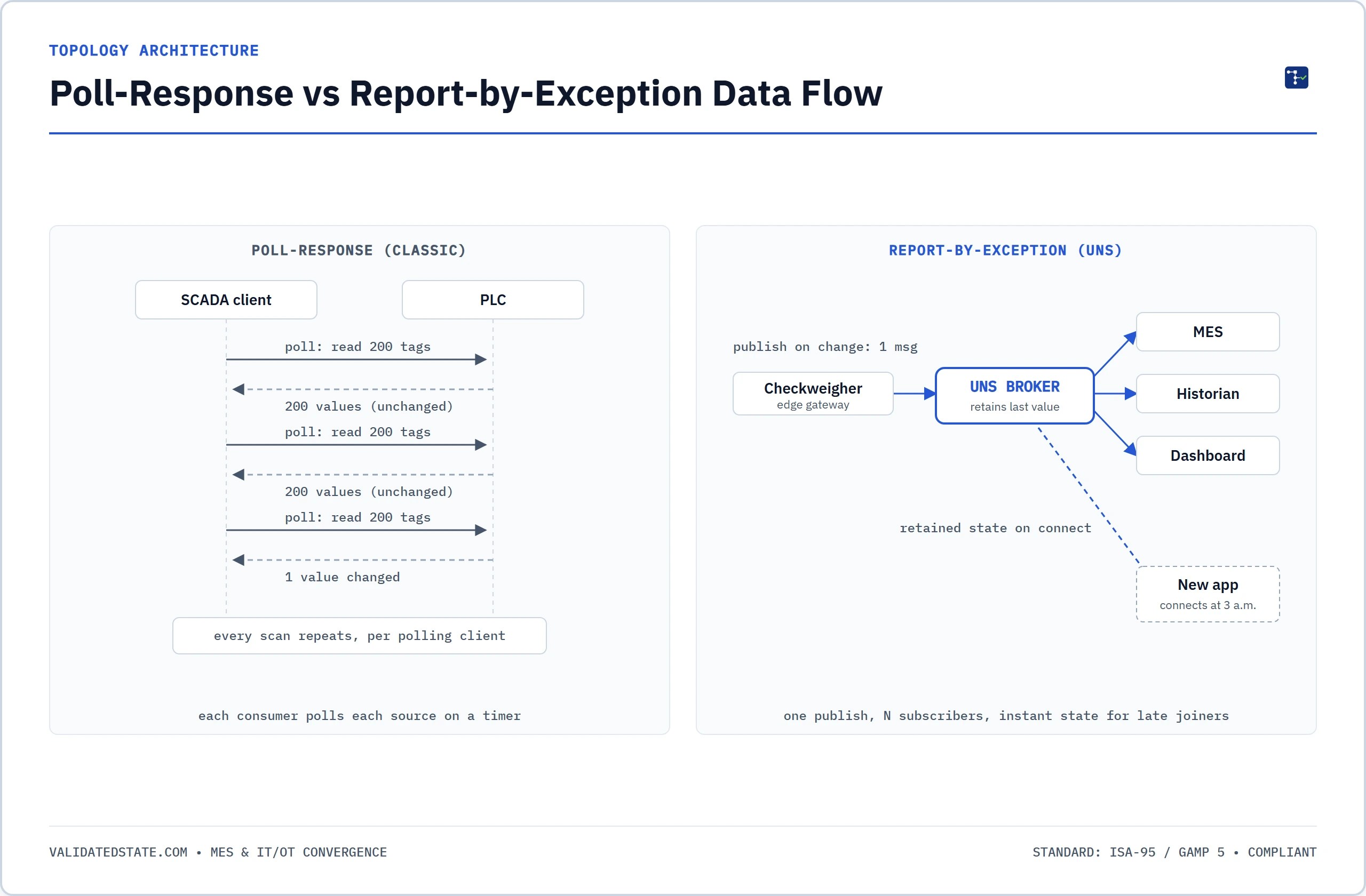
Classic industrial data collection is interrogative. A SCADA server polls each PLC on a scan cycle: ask, wait, receive, repeat, forever. Most answers are identical to the previous answer, because most process values change slowly relative to the scan rate. The network carries thousands of messages per second that contain no new information.
Polling: Asking Ten Thousand Questions Nobody Needed Answered
Polling also couples every consumer to every source. Each new application that wants line data must be given a route to the PLC, a protocol driver, and a scan budget. PLCs have finite communication capacity. I have watched a fourth polling client push a controller’s comms load past its limit and slow the scan of the control program itself. The data-consumption side of the business ends up physically constrained by the data-production side.
Retained State: Why a New Subscriber Sees the Plant Instantly
Report-by-exception inverts the direction. The device, or an edge gateway speaking for it, publishes when a value changes and stays silent otherwise. Once published, the broker delivers the event to every subscriber at once. The PLC answers one client (the broker connection) no matter how many consumers exist.
Retained messages complete the picture. Because the broker keeps the last value per topic, a subscriber that connects at 3 a.m. on Sunday receives the current state of every topic it subscribes to, immediately, without a single device being polled. New applications become cheap: subscribe, receive the world, and start working. That property, an instant and complete state of connection, is what makes the UNS feel like a single source of truth rather than a message pipe.
A Working Example: The Westbridge Packaging Site
Auralis Pharma is a fictional company I will reuse for the entire series. Its Westbridge site does secondary packaging: four areas (dispensing, blister packaging, bottle packaging, and palletizing) with two blister lines and one bottle line. Each line follows the ISA-88 physical model down to its cells: a blister former and filler, a checkweigher, a cartoner, a serialization vision station, and a case packer.
One Topic Path, End to End
Walk the canonical path once, left to right:
auralis / westbridge / blister-packaging / blst-01 / checkweigher / status / oee
Enterprise, site, area, line, cell, then the information leaf. The payload at that leaf is a small structured document, not a bare number:
{ "value": 84.2, "units": "%", "timestamp": "2026-07-20T06:41:03.120Z", "quality": "GOOD"}
The checkweigher’s edge gateway publishes this only when the OEE (Overall Equipment Effectiveness) figure changes. The MES subscribes to it for shift reporting. The historian subscribes and archives every change. A line dashboard subscribes to it and renders it. None of the three know the checkweigher’s IP address, protocol, or vendor. They know the topic. Payload design, units, and quality codes get a full article later in the series.
What About Security and Validation?
Centralizing every data flow through one broker concentrates risk, and I will not pretend otherwise. The broker becomes critical infrastructure, and IEC 62443, the industrial cybersecurity standard built on zones, conduits, and security levels, applies to it directly. A broker-centric architecture changes how zones and conduits are drawn, and that redesign deserves its own article later in this series rather than a paragraph here.
The same applies to regulated production. At a pharmaceutical site like Westbridge, data flowing through the UNS can feed batch records and quality decisions, which brings GAMP 5 and its data-integrity expectations (ALCOA+) into scope. Whether the broker itself needs validation, and to what category, depends on what consumes its data, a question I will treat properly in the validation article of this series.
Frequently Asked Questions (FAQ) on the Unified Namespace
Is a Unified Namespace the same thing as MQTT?
No. MQTT is a transport protocol; the UNS is an architecture. MQTT is the most common implementation choice because retained messages and broker fan-out match the UNS requirements almost exactly, but an MQTT broker with device-oriented flat topics is not a UNS, and a UNS could in principle run on another brokered transport.
Does a UNS replace my historian or MES?
No. The UNS holds the current state; the historian holds history; the MES executes manufacturing operations. Both become clients of the namespace: the historian subscribes and archives, and the MES publishes order and production state. Each system keeps its ISA-95 role. The UNS replaces the point-to-point wiring between them, not the systems themselves.
Can I build a UNS on OPC UA instead of MQTT?
OPC UA (Open Platform Communications Unified Architecture) is the dominant standard for machine connectivity, and it usually feeds the UNS at the edge rather than replacing it. Classic OPC UA is client-server, so hub-style distribution needs the PubSub extension or an OPC-UA-to-MQTT gateway. Edge integration patterns get their own article in this series.
How small can a UNS start, and is it worth it for a single line?
A UNS scales down well. One broker, one line, and a handful of topics under a correctly structured hierarchy are a legitimate starting point; the hierarchy, not the size, is what matters. Start with the full path even when one site and one line exist, so growth never forces a rename.
References
- ISA-95 / IEC 62264, Enterprise-Control System Integration, International Society of Automation, isa.org
- ISA-88 / IEC 61512, Batch Control, International Society of Automation, isa.org
- OASIS, MQTT Version 5.0 Specification, docs.oasis-open.org
- Eclipse Foundation, Sparkplug Specification, sparkplug.eclipse.org
- HiveMQ, The Ultimate Guide to the Unified Namespace, hivemq.com
- Walker Reynolds / 4.0 Solutions, Unified Namespace video series, youtube.com/@4.0Solutions
- ValidatedState, Using ISA-88 and ISA-95 Together, validatedstate.com
- ValidatedState, MES-DCS Integration Patterns, validatedstate.com
Leave a Reply