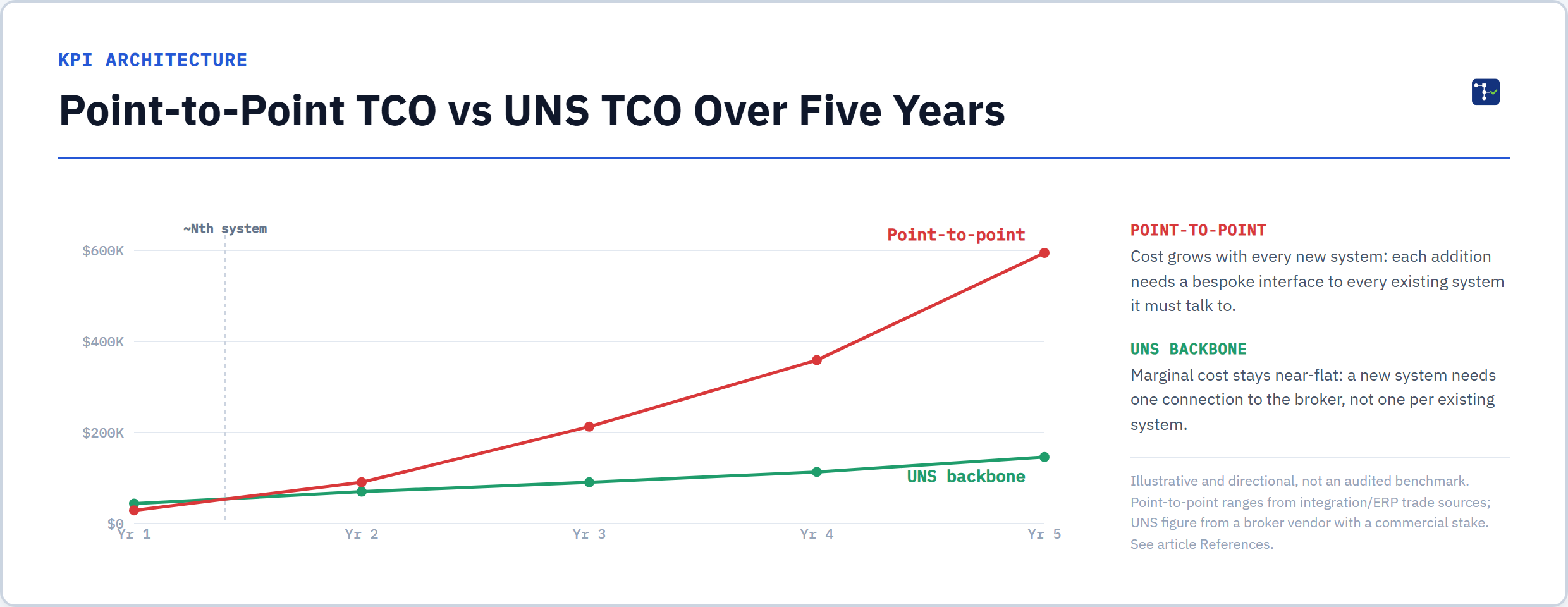
Point-to-point integration fails at scale because its cost and fragility grow combinatorially as systems are added, while its weakest links sit exactly at the ISA-95 level boundaries where organizational ownership also changes hands. A six-system plant wiring each system directly to every other system needs up to fifteen bespoke interfaces. Add a seventh system and that number jumps to twenty-one. The math is not the whole problem, but it is where the problem starts.
I introduced the unified namespace (UNS) in the first article of this series as a broker-centric alternative to this wiring. Here I stay on the failure mode itself: what point-to-point integration actually breaks, why ISA-95 predicts where it breaks, what it really costs over years rather than at the moment of purchase, and the concrete signals that say a plant has outgrown it.
Key Takeaways
- Point-to-point integration cost does not scale linearly with the number of systems. Full interconnection of N systems needs up to N x (N-1) / 2 interfaces: 15 for six systems, 21 for seven, 45 for ten.
- The most brittle interfaces sit at ISA-95 level boundaries (L1-L2, L2-L3, L3-L4), because that is where both the protocol and the team responsible for it change.
- Gartner reports that only 48% of digital initiatives meet or exceed their business outcome targets. In my experience the interfaces I audit as failing hardest are exactly the siloed, unowned point-to-point links this article describes, though Gartner’s own research attributes the broader gap to CIO and business co-ownership of delivery, not to integration architecture specifically.
- Migration triggers are specific and testable: can your team still produce a current integration diagram, and can an outage be traced to one interface within an hour?
- Point-to-point integration is not a mistake for a single connection or a small plant. It becomes technical debt only past a specific inflection point, not on day one.
Why Does Point-to-Point Integration Fail at Scale?
I define a unified namespace, at its foundation, as a broker, a semantic hierarchy, and live retained state, replacing direct wiring between systems with one connection per system into a shared hub. The failure mode I am describing here is the mirror image of that definition: what happens when every system instead gets wired directly to every other system it needs data from.
The N-Squared Problem, With Real Numbers
Full interconnection of N systems needs up to N x (N-1) / 2 point-to-point links. Six systems (SCADA, MES, ERP, historian, quality, maintenance) top out at fifteen interfaces. Add a seventh system, a serialization platform for a new regulatory requirement, and the ceiling jumps to twenty-one: six new interfaces for one new system, because each interface is built and maintained independently.
Real integration cost figures back this up before any combinatorics enter the picture. Reported benchmarks put simple point-to-point integrations at 3,000 to 15,000 dollars each and complex integrations at 15,000 to 100,000 dollars, with MES-to-ERP integration alone commonly running 25,000 to 150,000 dollars as one of the largest line items in a discrete manufacturer’s integration budget. Multiply either range by fifteen interfaces and the build cost alone justifies a second look at the architecture, before a single hour of ongoing maintenance is counted.
What Does a Point-to-Point Failure Actually Look Like?
Cost curves are abstract until an interface actually breaks. At Westbridge, three failure modes repeat across nearly every point-to-point plant I have looked at.
Brittle ETL: The 2 A.M. Schema Change Nobody Announced
The MES-to-ERP interface at Westbridge runs a nightly batch job that extracts completed work orders and pushes them into SAP as goods-receipt transactions. The mapping was hand-built against a specific MES schema version. When the MES vendor ships a minor upgrade that renames one field, the ETL job does not throw a loud error. It silently maps the wrong column, and finance discovers three days later that goods-receipt quantities do not reconcile. Nobody announced the schema change because, from the MES team’s perspective, it was an internal implementation detail. From the ETL job’s perspective, it was a contract violation.
Historian Silos: Three Systems, Three Versions of the Truth
Westbridge’s historian, MES, and a standalone OEE dashboard each ingest checkweigher data through separate point-to-point links built at different times by different integrators. The historian tags the reading in kilograms. The MES interface, built two years later by a different vendor, converts to grams before writing. The OEE dashboard queries the historian directly and assumes kilograms. Every one of these systems is technically correct in isolation. None of them agree with each other, and reconciling a single disputed batch record means pulling raw values from all three and manually checking units.
Cascading Outages: One Maintenance Window, Two Broken Interfaces
A planned SAP maintenance window at Westbridge takes the ERP system offline for four hours. The MES-to-ERP interface queues its work-order confirmations, which is fine. The quality system’s point-to-point link to ERP, however, was built by a different integrator without a queue, so every certificate-of-analysis lookup during the window fails outright rather than retrying. The maintenance system’s spare-parts interface, which polls ERP inventory every five minutes, floods the application log with connection errors that the on-call engineer has to manually distinguish from a genuine outage elsewhere. One planned four-hour window becomes three separate incident tickets, because three separate interfaces handled the same failure differently.

How Does ISA-95 Explain Where the Fragility Concentrates?
None of the three failures above happened at random. Each sits on an ISA-95 level boundary: SCADA-to-MES crosses L2 to L3, MES-to-ERP crosses L3 to L4, MES-to-historian crosses within L3 but between systems built by different vendors on different release cycles. ISA-95 was written to describe functional responsibility, not integration architecture, but the boundaries it draws turn out to predict exactly where point-to-point interfaces are most likely to break.
The reason is organizational, not technical. At most plants I have worked with, the OT team owns L1 and L2, a separate MES or manufacturing IT team owns L3, and a business systems team owns L4 ERP. A point-to-point interface that crosses one of these boundaries is jointly owned by two teams with different priorities, different change windows, and often different vendors. When the MES vendor ships an upgrade, the ERP team is not in the room. When SAP patches a field, the MES team finds out from a support ticket. The interface itself has no owner who can see both sides changing at once, which is exactly why the schema-drift failure at Westbridge went unannounced.
The interfaces themselves also inherit the physical-equipment naming from the ISA-88 model I used for Westbridge’s lines and cells in the first article, so a level-crossing interface breaking is never ambiguous about which specific checkweigher or cartoner is affected. A unified namespace collapses the ownership problem by giving every level a single, shared publish target instead of a private handshake per neighboring level. I cover the security and validation implications of that shift, IEC 62443 zones, and GAMP 5 categorization, in dedicated articles later in this series. The short version here: N bespoke interfaces also means N bespoke attack surfaces to secure and N separately validated data paths to maintain under GAMP 5, and both costs scale with the same combinatorics as the interfaces themselves.
What Is the True Cost of Point-to-Point Integration?
The purchase-order cost of an integration project is the smallest part of its total cost of ownership. Ongoing support, monitoring, and remediation accumulate quietly after go-live. Every system upgrade forces rework on every interface touching that system, not just a configuration change. Integration failures that require manual intervention carry a direct operational risk, and the fragility itself becomes an opportunity cost: teams delay automation and digital initiatives specifically because they distrust the integration layer underneath them.
For comparison, HiveMQ, a broker vendor with a direct commercial stake in the answer, publishes a figure of 25,000 to 50,000 dollars per year per site for a unified namespace backbone, a cost that does not increase with each additional system connected because every new system needs exactly one new connection to the broker rather than N new bespoke links. I have not been able to verify that range against an independent source, so I treat it as directional, not as fact, and the same caveat applies to the point-to-point cost ranges above, which come from integration and ERP trade blogs rather than an audited benchmark.
What I can verify from an analyst firm is the downstream risk of getting integration architecture wrong at all. Gartner’s October to November 2024 survey of 3,186 CIOs found only 48% of digital initiatives meet or exceed their business outcome targets, and named CIO and business co-ownership of delivery, not integration silos specifically, as the primary driver of the other 52%.
What Are the Signals That It Is Time to Migrate?
Point-to-point integration is not a mistake for a single connection, and a small single-line plant may never need anything else. The signals below are symptoms of having outgrown the architecture, not universal red flags.
Adding the next system has become a multi-week project instead of a configuration change, because every new system needs a bespoke interface built and tested against every existing system it must talk to. Nobody on the team can produce a current, accurate integration diagram from memory or documentation, which usually means the diagram stopped being maintained once it stopped being simple. An outage investigation cannot identify which interface is at fault within the first hour, because failures cascade silently across systems that were never designed to report their state to a common place. A new compliance requirement, serialization is the classic Westbridge example, needs data that three existing systems already hold, but no two of those systems agree on its format or units without a manual reconciliation step.
Any one of these on its own is tolerable. Two or three together, recurring, are the pattern that justifies the migration conversation I cover from the topic-hierarchy side in the next article of this series.

Frequently Asked Questions (FAQ) on Point-to-Point Integration Failure
Is point-to-point integration always wrong?
No. For one or two connections, or a single-line plant that will not grow, point-to-point is simpler to build and reason about than standing up a broker. It becomes a liability specifically as the number of systems and interfaces grows, not as a matter of principle.
Can I migrate incrementally, or does it have to be all at once?
Incrementally. A UNS broker can run alongside existing point-to-point interfaces during a transition; new systems connect to the broker while legacy interfaces are retired one at a time as their owning teams have capacity. I have not seen a plant successfully cut over all interfaces in a single event, and I would not recommend attempting one.
How is this different from just buying a better middleware or ESB?
An enterprise service bus centralizes routing logic but still typically models integrations as point-to-point mappings configured inside one tool, which reduces some maintenance burden without changing the underlying N-to-N relationship or introducing the semantic hierarchy and retained state that make a UNS a shared source of truth rather than a smarter switchboard.
References
- WorkCell, Manufacturing ERP Pricing: What to Expect in 2026, workcell.ai
- ERP Today, Choosing the Right Integration Strategy and Framework for Manufacturers, erp.today
- HiveMQ, The Business Value of Unified Namespace for Industry 4.0, hivemq.com
- Gartner, Digital Transformation Insights in Manufacturing, gartner.com
- ISA-95 / IEC 62264, Enterprise-Control System Integration, International Society of Automation, isa.org
- ValidatedState, What Is a Unified Namespace? A Ground-Up Definition, validatedstate.com
- ValidatedState, Understanding Modern MES Architecture and Its Impact, validatedstate.com
One response to “Why Point-to-Point Integration Fails at Scale”
[…] first article defined the term and placed it as a backbone spanning ISA-95 Levels 0 through 4. The second article showed why the bespoke interfaces a UNS replaces fail hardest at exactly the ISA-95 level […]