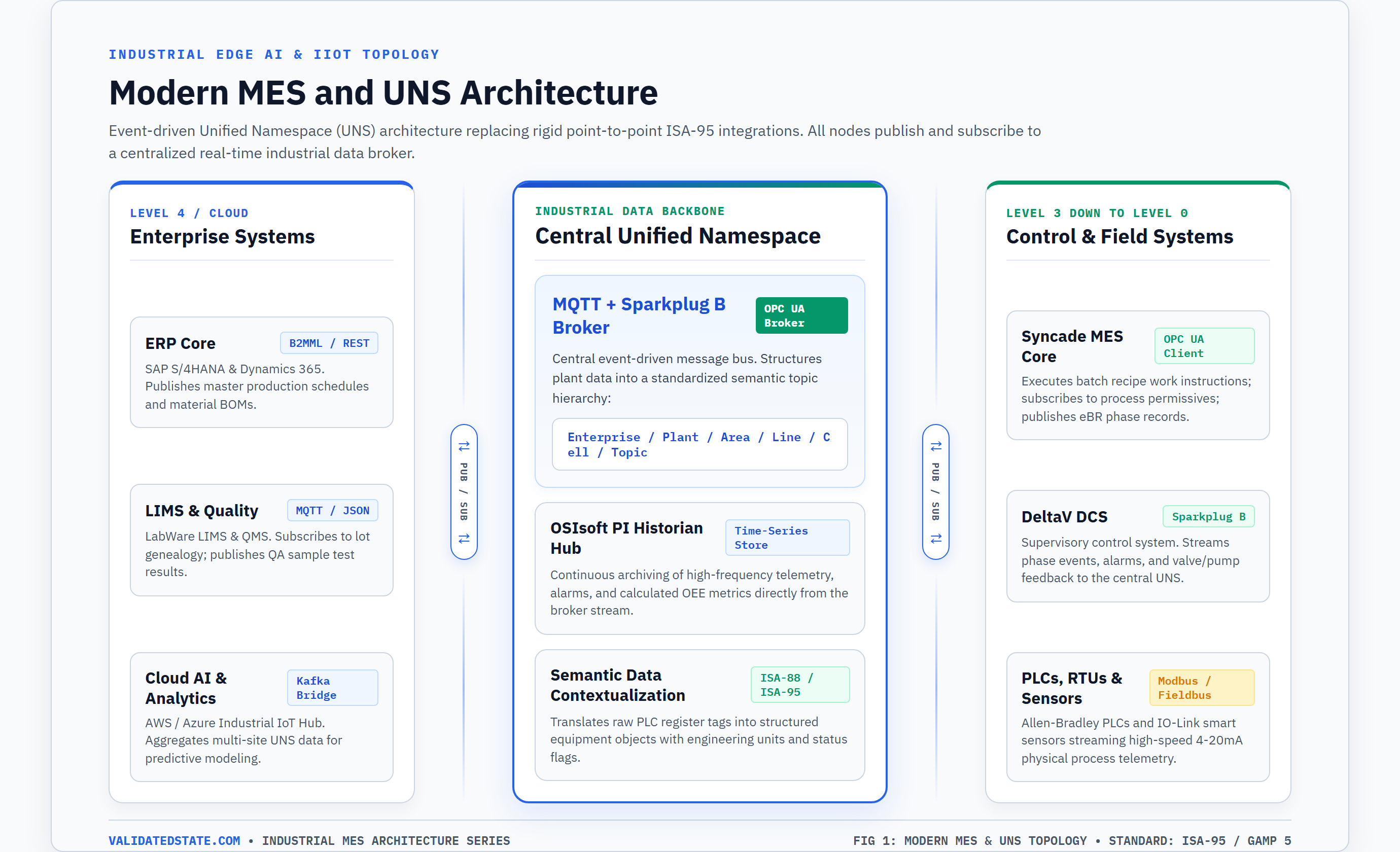
Modern Manufacturing Execution Systems are undergoing a fundamental transformation. In 2026, the Unified Namespace market reached USD 2.59 billion with a 16.20% CAGR, projected to hit USD 11.6 billion by 2036 as manufacturers replace rigid ISA-95 point-to-point integrations with event-driven, real-time data architectures, according to Future Market Insights.
By Vikas Phatak, Industrial Automation Architect with 15 years experience in MES and IIoT systems
Key Takeaways
- In 2026, the Unified Namespace market reached USD 2.59 billion with a 16.20% CAGR, projected to hit USD 11.6 billion by 2036 as manufacturers adopt event-driven architectures over rigid ISA-95 integrations to enable true Industry 4.0 capabilities (Future Market Insights, 2026).
- Manufacturing facilities implementing event-driven architectures achieved a 78.2% reduction in unplanned downtime and 81.2% faster Mean Time To Resolution through real-time data access and predictive maintenance capabilities (IJ SAT, 2025).
- The MQTT Sparkplug B broker market grew from USD 1.37 billion in 2024 and is expected to expand at a 22.1% CAGR through 2033, reaching USD 9.41 billion as industrial adoption of open messaging standards accelerates (Growth Market Reports, 2025).
- IT/OT convergence became a competitive requirement for manufacturers in 2026, with Gartner emphasizing the need to unify data foundations for AI-ready, agent-capable digital platforms that support autonomous operations (Gartner, 2026).
- The combination of UNS and the emerging i3X open standard creates a machine-readable semantic layer, allowing AI agents to access, interpret, and act on manufacturing data without custom integration for each use case (IIoT World, May 2026).

Table of Contents
- What Is Modern MES Architecture?
- Why Does Modern MES Architecture Matter in 2026?
- What Are the Core Components of Modern MES Architecture?
- How Does the Unified Namespace Work?
- What Protocol Stack Enables Field-to-Cloud Communication?
- What Implementation Framework Should You Follow?
- What Advanced Event-Driven Patterns Maximize Value?
- What Tools and Technologies Do You Need?
- How Do You Get Started with Modern MES Architecture?
- Frequently Asked Questions
- References
What Is Modern MES Architecture?
Modern MES architecture replaces traditional hierarchical ISA-95 point-to-point integrations with an event-driven Unified Namespace (UNS) that centralizes industrial data into a single, hierarchically organized source of truth. In 2026, this architectural pattern enables all nodes from PLCs to ERP systems to publish and subscribe to a centralized real-time industrial data broker. It eliminates the complexity and rigidity of traditional integrations.
The Unified Namespace is an architectural pattern that replaces traditional ISA-95 pyramidal industrial architectures by centralizing data from disparate systems, as HiveMQ’s industrial solutions team explains. It structures plant data into a standardized semantic topic hierarchy (Enterprise/Plant/Area/Line/Cell/Topic) that enables seamless data governance, sharing, and analytics across the entire manufacturing enterprise.
While traditional ISA-95 architectures move data up or down one layer at a time through point-to-point connections (a model that served its purpose in the 1990s), modern UNS architectures enable any system to access any data it needs through a publish-subscribe model. This dramatically reduces integration complexity.
Key Characteristics
- Event-driven: Data flows based on state changes and events, not polling
- Decentralized: No single point of failure; systems publish and subscribe independently
- Semantic: Data is contextualized with engineering units, status flags, and hierarchical relationships
- Real-time: Sub-millisecond latency for critical process control data
- Scalable: Linear scalability from single machines to multi-site enterprises
Common Misconceptions
Modern MES architecture is not simply adding MQTT to existing systems. It requires a fundamental shift from request-response patterns to publish-subscribe, from proprietary protocols to open standards, and from siloed data to a unified, contextualized namespace.
It is also not a replacement for all existing systems. Legacy PLCs, DCS, and ERP systems continue to operate, but their data integration model changes from point-to-point to hub-and-spoke via the UNS.

Why Does Modern MES Architecture Matter in 2026?
In 2026, manufacturers implementing event-driven architectures reduced unplanned downtime by 78.2% and achieved an 81.2% reduction in Mean Time To Resolution (MTTR), according to a 2025 study published in the International Journal of Scientific and Applied Research. These facilities also improved service reliability from three nines (99.9%) to five nines (99.999%) through advanced event monitoring patterns.
The global Manufacturing Execution Systems market itself reached USD 17.57 billion in 2025 and is projected to grow at 11.7% CAGR to USD 41.60 billion by 2033, according to Grand View Research. Meanwhile, the MQTT Sparkplug B broker market (critical infrastructure for UNS) grew from USD 1.37 billion in 2024 and is expected to expand at a 22.1% CAGR through 2033 (Growth Market Reports, 2025).
What Industry Trends Are Driving Adoption?
IT/OT Convergence as Competitive Requirement: In 2026, IT/OT convergence is no longer optional. It is a competitive requirement for manufacturers, according to 2WTech. The pressure to modernize operations, secure legacy equipment, and leverage real-time data has pushed this to the top of strategic agendas.
AI-Ready Data Foundations: Gartner’s 2026 manufacturing trends report emphasizes that manufacturers must unify data foundations to build contextualized, agent-ready data platforms. This enables AI agents to access, interpret, and act on manufacturing data without custom integration for each use case.
Event-Driven AI Integration: At IIoT World’s AI Manufacturing Day 2026, industry experts demonstrated how the combination of UNS and the emerging i3X open standard creates a machine-readable semantic layer. This allows AI applications to consume manufacturing data seamlessly. As IDC research shows, 90% of the world’s largest companies are now using real-time data (Ably, 2024).
What Are the Consequences of Legacy Approaches?
Manufacturers continuing with traditional point-to-point ISA-95 integrations face:
- Integration brittleness: Adding new systems requires custom connections to each existing system
- Data latency: Polling-based architectures introduce delays that mask real-time process variations
- Scalability limits: Linear growth in connections creates exponential complexity
- Maintenance burden: Each integration point requires separate maintenance and version management
- Innovation blockade: New technologies (AI, digital twins, predictive analytics) cannot access siloed data
What Opportunities Does Modern MES Architecture Provide?
Organizations adopting modern MES architectures report:
- 78.2% reduction in unplanned downtime through predictive maintenance enabled by real-time data
- 81.2% faster issue resolution via event-driven alerting and correlation
- 68.7% reduction in system complexity through decentralized, decoupled architectures
- Orders of magnitude cost savings in integration and maintenance (IIoT World, June 2026)

What Are the Core Components of Modern MES Architecture?
The modern MES architecture comprises three primary layers, connected through a central Unified Namespace that serves as the industrial data backbone. This structure enables seamless data flow from field devices to enterprise systems without point-to-point integrations.
Level 4 / Cloud: Enterprise Systems
Enterprise systems represent the business and planning layer, where strategic decisions are made based on aggregated production data. In 2026, these systems increasingly consume real-time operational data from the UNS rather than relying on batch reports or manual data entry.
ERP Core
SAP S/4HANA & Dynamics 365 publish master production schedules and material Bills of Materials to the UNS via B2MML/REST interfaces. This enables real-time synchronization between business planning and shop-floor execution, eliminating the traditional 24-48 hour lag in production schedule updates.
Key capabilities:
- Real-time production order status visibility
- Automated material consumption tracking
- Dynamic rescheduling based on actual vs. planned performance
- Integrated quality and compliance reporting
LIMS & Quality
LabWare LIMS & QMS systems subscribe to lot genealogy data from the UNS and publish QA sample test results via MQTT/JSON. This creates a closed-loop quality system where production events trigger automatic sample collection, test results are immediately available to all stakeholders, and non-conformance events trigger automatic containment actions.
Typical data flows:
- Subscribes to: Process parameters, batch IDs, material lots
- Publishes: Test results, specifications, non-conformance reports
- Frequency: Real-time to near-real-time (seconds to minutes)
Cloud AI & Analytics
AWS / Azure Industrial IoT Hub aggregate multi-site UNS data for predictive modeling via Kafka Bridge. In 2026, cloud-based AI and analytics represent the fastest-growing segment of MES-related spending, as manufacturers leverage multi-site pattern recognition, predictive maintenance, demand forecasting, and energy optimization.
Cloud AI systems consume UNS data through Kafka bridges, which provide the necessary buffering and protocol translation between MQTT’s pub/sub model and Kafka’s log-based streaming. This enables both real-time processing and historical analysis from the same data pipeline.
Industrial Data Backbone: Central Unified Namespace
The Central Unified Namespace is the heart of modern MES architecture, providing a single source of truth for all industrial data. Unlike traditional architectures where data is copied and transformed at each layer, UNS maintains a single, canonical representation that all systems can access.
MQTT + Sparkplug B Broker
The MQTT protocol with Sparkplug B specification forms the core of the UNS, providing an open, lightweight, and reliable publish-subscribe messaging transport. As one MQTT co-inventor stated, Sparkplug B brings MQTT back to its original industrial market sector.
Key features:
- OPC UA Client integration: Native support for OPC UA data models
- Report-by-exception: Only transmits data when values change
- Session management: Automatic state synchronization when clients reconnect
- Topic namespace: Standardized hierarchy (Enterprise/Plant/Area/Line/Cell/Topic)
- Payload specification: Structured data with metadata, timestamps, and quality codes
Market momentum: The MQTT Sparkplug B broker market reached USD 1.37 billion in 2024 and is projected to grow at 22.1% CAGR through 2033 (Growth Market Reports, 2025).
OSIsoft PI Historian Hub
The Time-Series Store provides continuous archiving of high-frequency telemetry, alarms, and calculated OEE metrics directly from the broker stream. It subscribes to UNS topics of interest, stores raw and aggregated data, provides query interfaces for analytics tools, and maintains data integrity and timestamp accuracy.
Semantic Data Contextualization
ISA-88 / ISA-95 compliant contextualization translates raw PLC register tags into structured equipment objects with engineering units and status flags. Implementation includes tag mapping, ontology management, unit conversion, validation, and status/quality code standardization.

Level 3 to Level 0: Control & Field Systems
Control and field systems represent the operational technology layer, where physical processes are controlled and monitored. In modern MES architecture, these systems both consume and produce data via the UNS.
Syncade MES Core
The OPC UA Client executes batch recipe work instructions, subscribes to process permissives, and publishes electronic Batch Records phase records. It subscribes to recipe parameters, process permissives, and equipment status while publishing batch phase records, material consumption, and process alarms at sub-second to second intervals.
DeltaV DCS
The Sparkplug B enabled Distributed Control System streams phase events, alarms, and valve/pump feedback to the central UNS. This provides real-time visibility into control system state, unified alarm management, historical data for optimization, and seamless integration with MES and ERP.
PLCs, RTUs & Sensors
Allen-Bradley PLCs and IO-Link smart sensors stream high-speed 4-20mA physical process telemetry via Modbus / Fieldbus protocols. Protocol bridging includes Modbus TCP/RTU to MQTT, Fieldbus to MQTT, OPC UA server at PLC level, and protocol translation and data normalization.
How Does the Unified Namespace Work?
The Unified Namespace operates on a publish-subscribe model where data producers publish messages to topics, and data consumers subscribe to topics of interest. This decoupled architecture enables any system to access any data without requiring direct point-to-point connections.
How Does the Pub/Sub Model Function?
- Producers (PLCs, DCS, MES, ERP) publish data to specific topics
- Broker (MQTT + Sparkplug B) receives and routes messages to subscribers
- Consumers (Analytics, LIMS, Historian, AI) subscribe to topics and receive relevant data
Key advantages:
- Decoupling: Producers and consumers do not need to know about each other
- Scalability: Adding new consumers does not impact producers
- Flexibility: Consumers can subscribe to multiple topics and filter as needed
- Resilience: Broker provides buffering and guaranteed delivery options
What Is the Topic Hierarchy?
The standardized UNS topic hierarchy follows: Enterprise/Plant/Area/Line/Cell/Topic
Example:
NorthAmerica/ChicagoPlant/PackagingLine/Line1/FillerA/TemperatureNorthAmerica/ChicagoPlant/PackagingLine/Line1/FillerA/PressureNorthAmerica/ChicagoPlant/PackagingLine/Line1/FillerA/Status
How Does Data Flow Through the System?
Consider a temperature sensor on a filling machine:
- PLC reads temperature every 100ms and detects a change
- PLC publishes to:
NorthAmerica/ChicagoPlant/PackagingLine/Line1/FillerA/Temperature - Payload includes: value, timestamp, quality code, engineering units
- MES subscribes to all FillerA topics and receives the temperature update
- Historian subscribes to all temperature topics and stores the value
- DCS subscribes to FillerA topics and uses temperature for control decisions
- ERP subscribes to aggregated OEE topics and updates production records
All this happens in real-time, with no point-to-point connections.

What Protocol Stack Enables Field-to-Cloud Communication?
Modern MES architecture requires a protocol stack that enables seamless communication from field level to cloud analytics, with appropriate protocol translation at each layer.
Field Level (Level 0-1)
Protocols: Modbus, Fieldbus, Ethernet/IP, IO-Link
- High-speed, deterministic communication
- Real-time control requirements
- Protocol-specific gateways and bridges
Control Level (Level 2-3)
Protocols: OPC UA, MQTT, Sparkplug B
- Supervisory control and monitoring
- Native MQTT/Sparkplug B support in modern controllers
- OPC UA to MQTT bridging for legacy systems
Enterprise Level (Level 4+)
Protocols: REST, B2MML, JSON, Kafka
- Business system integration
- MQTT to REST/JSON gateways
- API management for enterprise systems
Cloud Analytics Level
Protocols: Kafka, MQTT, AMQP
- Massive scalability requirements
- Advanced analytics and AI/ML
- Edge filtering to reduce data volume

What Implementation Framework Should You Follow?
Adopting modern MES architecture requires a structured approach addressing technology, processes, and people. Based on 2026 industry best practices, here is a proven four-phase framework.
Phase 1: Assessment & Planning (4-8 weeks)
Objective: Understand current state and define target architecture
Key activities:
- Inventory existing systems
- Map data flows
- Define use cases
- Select UNS platform
- Design topic hierarchy
- Establish governance
Deliverables: Assessment report, target architecture, business case, roadmap
Phase 2: Pilot (8-12 weeks)
Objective: Prove the architecture with limited scope
Key activities:
- Deploy UNS broker
- Integrate pilot line
- Connect enterprise systems
- Implement data contextualization
- Deploy historian
- Test and validate
Success criteria: All pilot data in UNS, real-time visibility, 50%+ integration complexity reduction
Phase 3: Scale & Expand (6-12 months)
Objective: Roll out to additional lines and systems
Key activities:
- Expand line coverage
- Add enterprise systems
- Deploy analytics
- Enhance security
- Optimize performance
- Establish operations
Phase 4: Optimize & Innovate (Ongoing)
Objective: Continuously improve and add capabilities
Key activities:
- Advanced analytics (AI/ML)
- Digital twins
- Edge computing
- Cloud integration
What Common Pitfalls Should You Avoid?
- Starting too big: Begin with a focused pilot
- Ignoring data governance: Establish clear ownership and quality standards
- Underestimating culture change: IT/OT collaboration is essential
- Neglecting security: Implement zero-trust and access controls
- Overlooking performance: Proper capacity planning is critical
In successful implementations, the pilot phase often reveals unexpected data quality issues. One manufacturer discovered 30% of PLC tags had incorrect engineering units, which would have caused significant problems if not caught early.
What Advanced Event-Driven Patterns Maximize Value?
For experienced practitioners ready to maximize value, these advanced patterns deliver significant benefits.
What Is Event Sourcing?
Store all state changes as a sequence of events for complete audit trail and time-travel debugging. This enables reconstructing any past state, event replay for testing, and temporal queries.
What Is CQRS?
Separate read and write models to optimize performance and scalability. In manufacturing, the command side handles production orders and recipe changes while the query side provides dashboards and reports.
What Is Event-Driven Choreography?
Replace centralized orchestration with decentralized services reacting to events. This pattern reduces system complexity by 68.7% (IJ SAT, 2025), improves fault isolation, enables independent service evolution, and supports microservices architecture.
What Is the Saga Pattern?
Manage distributed transactions across multiple services using sequences of local transactions coordinated through events. Examples include order fulfillment and maintenance workflows.
What Edge Computing Patterns Should You Use?
Deploy computation at the edge for filtering, aggregation, inference, and control to reduce latency and bandwidth requirements.

What Tools and Technologies Do You Need?
Building modern MES architecture requires selecting the right tools for each layer.
What MQTT Brokers Are Available?
| Tool | Description | Best For | License |
|---|---|---|---|
| HiveMQ | Enterprise-grade with Sparkplug B | Large enterprises | Commercial |
| EMQX | Highly scalable, open-source | High-volume deployments | Open Source / Commercial |
| Mosquitto | Lightweight, open-source | Small to medium | Open Source (EPL) |
| Vernemq | Distributed with clustering | Scalable deployments | Open Source (Apache 2.0) |
What Protocol Bridges Are Needed?
| Tool | Description | Protocols |
|---|---|---|
| Kafka Bridge | MQTT to Kafka | MQTT ↔ Kafka |
| OPC UA to MQTT | OPC UA translation | OPC UA ↔ MQTT |
| Modbus to MQTT | Modbus device bridge | Modbus ↔ MQTT |
What Cloud Platforms Support This?
| Platform | Description | Key Features |
|---|---|---|
| AWS IoT Core | Managed MQTT broker | Device gateway, rules engine |
| Azure IoT Hub | IoT device management | Device twin, event hub |
| Google Cloud IoT | IoT with Pub/Sub | BigQuery analytics |
HiveMQ and EMQX are most commonly selected for large-scale industrial applications due to Sparkplug B support and scalability. Mosquitto’s lightweight nature makes it popular for edge deployments.
How Do You Get Started with Modern MES Architecture?
First step: Select a pilot production line and deploy an MQTT broker with Sparkplug B support.
Step 1: Choose Your Pilot (1 week)
Select a line with clear business value, typical complexity, and supportive stakeholders in both IT and OT.
Step 2: Deploy UNS Infrastructure (2 weeks)
Set up MQTT broker, enable Sparkplug B, configure security (TLS, authentication, authorization), and set up monitoring and alerting.
Step 3: Connect Pilot Line (3-4 weeks)
Integrate PLCs/DCS, implement data contextualization (tag mapping, unit conversion), configure topic hierarchy, and test data flows.
Step 4: Connect Enterprise Systems (2-3 weeks)
Connect MES, ERP, historian, and implement basic dashboards and reports.
Step 5: Validate & Measure (2 weeks)
Test all use cases, measure performance (latency, throughput, reliability), validate data accuracy, and document lessons learned.
Encouragement: Modern MES architecture is designed for non-disruptive deployment. Run UNS in parallel with existing integrations, validate, then migrate applications one at a time. Most manufacturers find the pilot phase itself delivers enough value to justify the investment.
Frequently Asked Questions
What is a Unified Namespace (UNS)?
A Unified Namespace is an architectural pattern that replaces traditional ISA-95 point-to-point industrial architectures by centralizing data from disparate systems into a single, hierarchically organized source of truth. In 2026, UNS is the backbone of next-generation smart manufacturing, with the market reaching USD 2.59 billion (Future Market Insights).
How does UNS differ from traditional MES integrations?
Traditional MES uses point-to-point ISA-95 integrations where data moves through custom connections. UNS replaces this with a centralized pub/sub model where all systems connect to a common data broker, eliminating integration complexity and reducing latency.
What protocols are supported in modern MES architecture?
Field level uses Modbus, Fieldbus, Ethernet/IP, and IO-Link. Control level uses OPC UA, MQTT, and Sparkplug B. Enterprise level uses REST, B2MML, JSON, and Kafka. Cloud level uses Kafka, MQTT, and AMQP. Protocol bridges enable seamless translation between these layers.
What is the implementation timeline and cost?
Assessment takes 4-8 weeks, pilot takes 8-12 weeks, scaling takes 6-12 months, and optimization is ongoing. Costs are typically 50-70% lower than traditional approaches due to reduced complexity and reusable infrastructure. The MQTT Sparkplug B market grows at 22.1% CAGR (Growth Market Reports, 2025).
Can I migrate from legacy systems without starting over?
Yes. Run UNS in parallel with existing integrations using protocol bridges. Most manufacturers start with a pilot line, prove the architecture, then gradually migrate applications without disrupting production.
How does Sparkplug B improve on standard MQTT?
Sparkplug B adds industrial-specific features including standardized topic namespace, structured payloads with metadata, session management for state synchronization, and report-by-exception to reduce network traffic. The specification is widely adopted in 2026, with the broker market growing at 22.1% CAGR (Growth Market Reports).
What are the security considerations for UNS?
Key considerations include TLS encryption for all communications, authentication using certificates or credentials, granular authorization based on topic hierarchy, zero-trust architecture principles, and network segmentation between IT and OT zones. Manufacturers are increasingly adopting secure MQTT brokers with granular access controls (Access NewsWire, March 2026).
How does UNS enable AI and digital twins?
UNS provides the real-time data foundation that AI and digital twins require. The combination of UNS and the emerging i3X open standard creates a machine-readable semantic layer, allowing AI agents to access, interpret, and act on manufacturing data without custom integration for each use case (IIoT World, May 2026).
What is the relationship between UNS and ISA-95?
UNS replaces rigid point-to-point connections of ISA-95 while preserving the hierarchical model. The UNS topic hierarchy aligns with ISA-95 levels but enables any system to access any data. Semantic contextualization uses ISA-88 and ISA-95 standards to translate raw data into structured equipment objects, maintaining compliance while gaining flexibility.
References
Market Data & Trends:
- [Future Market Insights], [Unified Namespace Market Size, Share & Forecast to 2036], [https://www.futuremarketinsights.com/reports/unified-namespace-market] (Retrieved July 4, 2026)
- [Access NewsWire], [Unified Namespace Market to Surpass USD 11.6 Billion by 2036], [https://www.accessnewswire.com/newsroom/en/business-and-professional-services/unified-namespace-market-to-surpass-usd-11.6-billion-by-2036-as-1148846] (Retrieved July 4, 2026)
- [Growth Market Reports], [MQTT Sparkplug B Broker Market Research Report 2033], [https://growthmarketreports.com/report/mqtt-sparkplug-b-broker-market/amp] (Retrieved July 4, 2026)
- [Grand View Research], [Manufacturing Execution Systems Market Size Report, 2033], [https://www.grandviewresearch.com/industry-analysis/manufacturing-execution-systems-market-report] (Retrieved July 4, 2026)
- [Mordor Intelligence], [Manufacturing Execution Systems Market Size & Growth Trends, 2031], [https://www.mordorintelligence.com/industry-reports/manufacturing-execution-systems-market] (Retrieved July 4, 2026)
Technical Sources:
- [HiveMQ], [What is Unified Namespace (UNS) and Why Does it Matter?], [https://www.hivemq.com/blog/what-is-unified-namespace-uns-iiot-industry-40/] (Retrieved July 4, 2026)
- [IIoT World], [What Is a Unified Namespace (UNS)?], [https://www.iiot-world.com/smart-manufacturing/what-is-a-unified-namespace-and-how-does-it-work-in-manufacturing/] (Retrieved July 4, 2026)
- [Eclipse Foundation], [Eclipse Sparkplug Working Group], [https://sparkplug.eclipse.org/] (Retrieved July 4, 2026)
- [Opto 22], [Industrial-strength MQTT/Sparkplug B], [https://www.opto22.com/articles/industrial-strength-mqtt-sparkplug-b] (Retrieved July 4, 2026)
Research & Analysis:
- [IJ SAT], [Event-Driven Architectures: The Foundation of Modern Industrial Systems], [https://www.ijsat.org/papers/2025/1/2907.pdf] (Retrieved July 4, 2026)
- [MIT Technology Review], [Enabling real-time responsiveness with event-driven architecture], [https://www.technologyreview.com/2025/10/06/1124323/enabling-real-time-responsiveness-with-event-driven-architecture/] (Retrieved July 4, 2026)
- [Ably], [Event-driven architecture: Everything you need to know], [https://ably.com/topic/event-driven-architecture] (Retrieved July 4, 2026)
Industry Insights:
- [BizTech Magazine], [Bridging the Divide: Navigating IT/OT Convergence in Modern Manufacturing], [https://biztechmagazine.com/article/2026/05/bridging-divide-navigating-itot-convergence-modern-manufacturing] (Retrieved July 4, 2026)
- [2WTech], [IT/OT Convergence: What Manufacturers Must Get Right in 2026], [https://2wtech.com/it-ot-convergence-what-manufacturers-must-get-right-in-2026/] (Retrieved July 4, 2026)
- [Synera], [Gartner Manufacturing Trends 2026], [https://www.synera.io/analyst-study/gartner-manufacturing-trends-2026] (Retrieved July 4, 2026)
One response to “Understanding Modern MES Architecture and its Impact”
[…] ValidatedState, Understanding Modern MES Architecture and Its Impact, validatedstate.com […]